
Biographical Notes
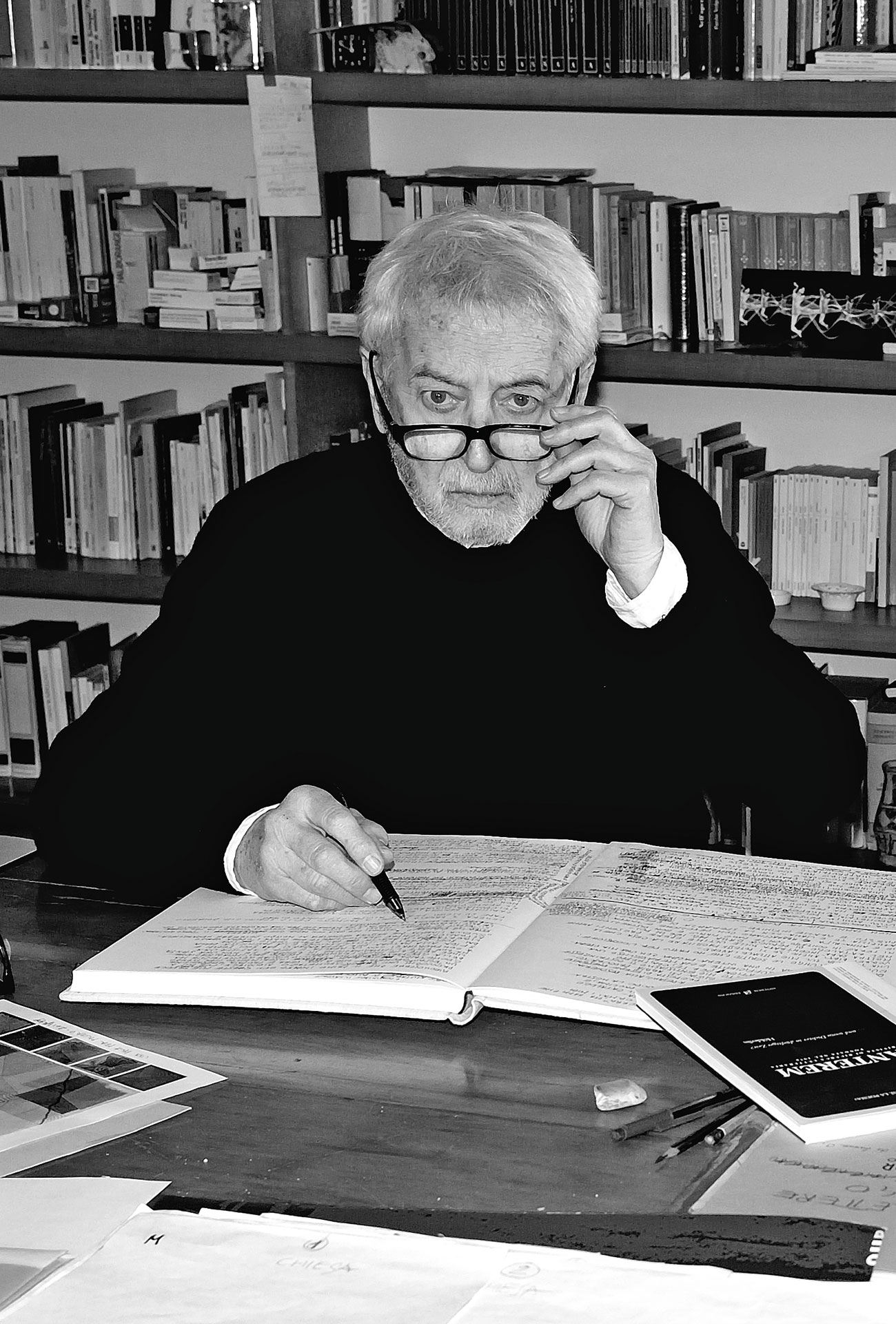
The passion for painting, which had emerged when he was a boy, would accompany Oscar Piattella (1932–2023) throughout his life. Painting had, in a sense, sought him out when, in the early 1950s, two young teachers of his own generation came to board at the large family home in Pesaro: they would later become the well-known artists Giuliano Vangi and Loreno Sguanci.
In the dynamic post-war period, a remarkable group of artists took shape in Pesaro, engaged in constant dialogue and linked by friendships and professional relationships. In both number and stature, the group was unparalleled not only within the province, and it played a decisive role in breaking new cultural ground in the Adriatic city, transforming it into a point of reference extending beyond the region.
For Piattella, the relationships begun when people in Pesaro were still walking among the ruins of the war would help consolidate talents seeking intellectual space and stimulating exchange. His initially figurative painting, centred on psychologically well-defined portraits, had already given way, by the mid-1950s, to a new sensibility. Largely self-taught, he had begun by filling a sketchbook with drawings of the landscape around Mount Catria, which Russoli would describe as “that beautiful album of notes, so intense, genuine and immediate”. Yet landscape would soon become something else for him, no longer a vast primer of nature from which to draw pictorial motifs of a figurative character. The 1955 painting La Rocca, exhibited for the first time at the Pesaro exhibition in 2020, reveals in nuce the early intuition of the formidable theme of the wall, which within only a few years underwent a rapid development leading to the accomplished, mature series exhibited in 1958 at Galleria l’Ariete in Milan, with an authoritative critical introduction by Franco Russoli.
This transformation of language, which Piattella developed rapidly and with great assurance, took place precisely during his youth in Pesaro. Here he formed strong and lasting relationships with Bruno Baratti, Renato Bertini, Bruno Bruni, Sandro Gallucci (his first teacher) and Nanni Valentini. And in that same Pesaro, where sculpture also bore the formidable imprint of Arnaldo Pomodoro and his brother Giò, Piattella shared a studio, at different times, with the sculptor Vangi and the sculptor-modeller Nanni Valentini.
As Pesaro emerged as a beacon for contemporary art in the Marche, the surrounding hill country became home to the important Arte Povera experiences that coalesced around Pier Paolo Calzolari, a friend of the writer Paolo Volponi, who, after his early years teaching at the Accademia di Belle Arti in Urbino (opened in 1967), would work for many years from his studio in Fossombrone. Meanwhile, in Cagli, in the shadow of the Apennines, the sculptor Eliseo Mattiacci was developing his practice; after his experiences and successes in Rome and internationally, he would eventually choose Pesaro.
Arnaldo Pomodoro’s presence led Pesaro, in 1971, to inaugurate a period devoted to sculpture in the urban environment and, in 1990, to the creation of the Centro TAM in Pietrarubbia; Eliseo Mattiacci’s presence prompted the establishment, in 1991, of the Centro di Scultura Contemporanea Torre Martiniana in Cagli; and that of Loreno Sguanci led to the foundation, in 1996, of the Centro Arti Visive Pescheria in Pesaro. Piattella, for his part, encouraged the identification in Cantiano of a space dedicated to contemporary art, placing on temporary deposit monumental works representing the wall.
Piattella was undoubtedly a painter capable of harnessing light to make matter vibrate: matter alchemically measured and manipulated, with which he constructed a large part of his paintings.
His creativity, however, was by no means confined to the two-dimensional surface of the painting. One emblematic example is the monumental polychrome stained-glass apse (6 m diameter, 17 m high, 10 m wide) in the transept of the Santuario di Nostra Signora della Salute in Turin, at the base of which stands the marble and crystal urn containing the body of Saint Leonardo Murialdo. Over two years of work in the early 1990s, using the traditional technique of leaded stained glass, no fewer than 13,000 pieces of mouth-blown glass were cut.
During a journey to Paris in 1957, Piattella was able to engage directly with the experiences of European Art Informel and with new developments in abstraction among French and Catalan artists. The impression made by old Parisian buildings, their walls still bearing the horrors of war, led him to reconsider pictorial space and the surface, which in this way became enriched with new chromatic qualities and proliferating signs.
Shortly afterwards, in 1958, he met Franco Russoli, then director of the Pinacoteca di Brera and an authoritative figure in contemporary art criticism, who appreciated several of his works in the Milan studio of his close friend Nanni Valentini. In Milan, Piattella came into contact with an artistic milieu of strongly international character and formed friendships with Piero Dorazio, Enrico Castellani, Pietro Cascella, Mario Nigro, Lucio Fontana, Tancredi, Ettore Sottsass, the photographer Ugo Mulas and other figures on the European art scene. In particular, he was in frequent contact with Arnaldo and Giò Pomodoro, Paolo Schiavocampo, Giuseppe Spagnulo, Albert Diatò, Claudio Olivieri and Walter Valentini.
He was invited to international exhibitions and exhibited at major galleries in Italy and abroad, while his works entered prestigious public and private collections.
Over the years, his intensive research brought his painting widespread recognition from both leading critics and a broad international public. Numerous major retrospective exhibitions, particularly in his later years, were held in institutional venues in Italy and abroad.
From the mid-1970s onwards, he developed an interest in printmaking and the production of artists’ books, both in multiple editions and as unique works. Among these were the portfolio Sette movimenti in bianco/nero, accompanied by seven unpublished poems by Cesare Vivaldi, in 1977; an edition of Dante Alighieri’s Divina Commedia in three volumes, with one hundred original drawings in each copy, in 2007; and LaLuce, written together with the psychiatrist Ugo Amati, also in 2007.
Numerous critics have engaged with his work through scholarly texts and articles in specialist journals. Among them are Martine Arnault, Ivana Baldassarri, Tiziano Broggiato, Massimo Cacciari, Luciano Caramel, Luca Cesari, Enrico Crispolti, Fabrizio D’amico, Lucio Del Gobbo, Andrea Emiliani, Armando Ginesi, Nunzio Giustozzi, March Herrisè, Aldo Iori, Gilbert Lascau, Francesco Lista, Alberto Mazzacchera, Lucilla Niccolini, Feliciano Paoli, Sandro Parmiggiani, Giancarlo Politi, Michele Polverari, Franco Russoli, Roberto Sanesi, Francesco Scoppola, Daniela Simoni, Italo Tomassoni, Duccio Trombadori, Miklos N. Varga, Cesare Vivaldi and Francesco Vincitorio.
For many years Piattella also directed his interests towards poetry, establishing working relationships and friendships with a number of international poets, including Yves Bonnefoy, Anna Buoninsegni, Gianni D’Elia, Eugenio De Signoribus, Franco Loi, Bernard Noël, Francesco Scarabicchi, Maria Luisa Spaziani and Fabio Scotto, who dedicated essays, poems and prose writings to him.
From 1958, Piattella lived in Cantiano, in his “hermit-like” studio along the ancient Roman Via Flaminia in the Umbrian-Marche Apennines, developing a special relationship with Gubbio, his sacred city, while always maintaining close and vital ties with Pesaro and its exceptional group of artists.
The mark left by artists on the places in which they live has always been profound and often endures over time. This is all the more true when we encounter artists who, like Piattella, possessed the intuition—later transformed over the years into full awareness—of their role both as masters, capable of innovating techniques and languages within the course of genuine research, and, at the same time, as men of thought and modern intellectuals.